
If you’ve heard the term “furnished unit relocation” and assumed it just means booking a hotel for a few weeks, you’re not alone in that assumption. But that’s not what it means, and the distinction matters. A furnished unit relocation is a structured housing arrangement where you move into a fully equipped rental unit, complete with furniture, appliances, and utilities, for a defined period during a move or life transition. It sits squarely between a hotel stay and a traditional lease, and for the right situations, it’s one of the most practical housing options available.
Table of Contents
Key takeaways
| Point | Details |
|---|---|
| Furnished unit defined | A move-in ready rental that includes furniture, utilities, and household essentials for a set period. |
| Cost advantage is real | Companies save 30% or more compared to business hotels by using furnished corporate housing. |
| Flexible lease terms | Most furnished units support stays from 30 days to 12 months, giving you room to adjust as plans change. |
| Not the same as turnkey | Furnished and turnkey units differ in what’s included, and knowing the gap helps you set accurate expectations. |
| Financial responsibility varies | Employers often cover job-related stays, while personal relocations may qualify for IRS tax deductions. |
What a furnished unit relocation actually entails
The term “furnished unit relocation” refers to the process of temporarily housing yourself or your family in a fully equipped rental unit as part of a move. It’s distinct from simply renting a furnished apartment on your own because it usually happens within a structured relocation scenario: a job transfer, a family move between cities, an insurance displacement after a home becomes uninhabitable, or a military assignment.
What’s actually included in these units varies, but standard furnished rentals cover stays from 30 days to 12 months and come with furniture, utilities, Wi-Fi, and housewares as part of the arrangement. You walk in with your suitcases and the space is ready to live in. That’s the defining feature of furnished unit relocation: zero setup time.
Furnished vs. fully furnished vs. turnkey
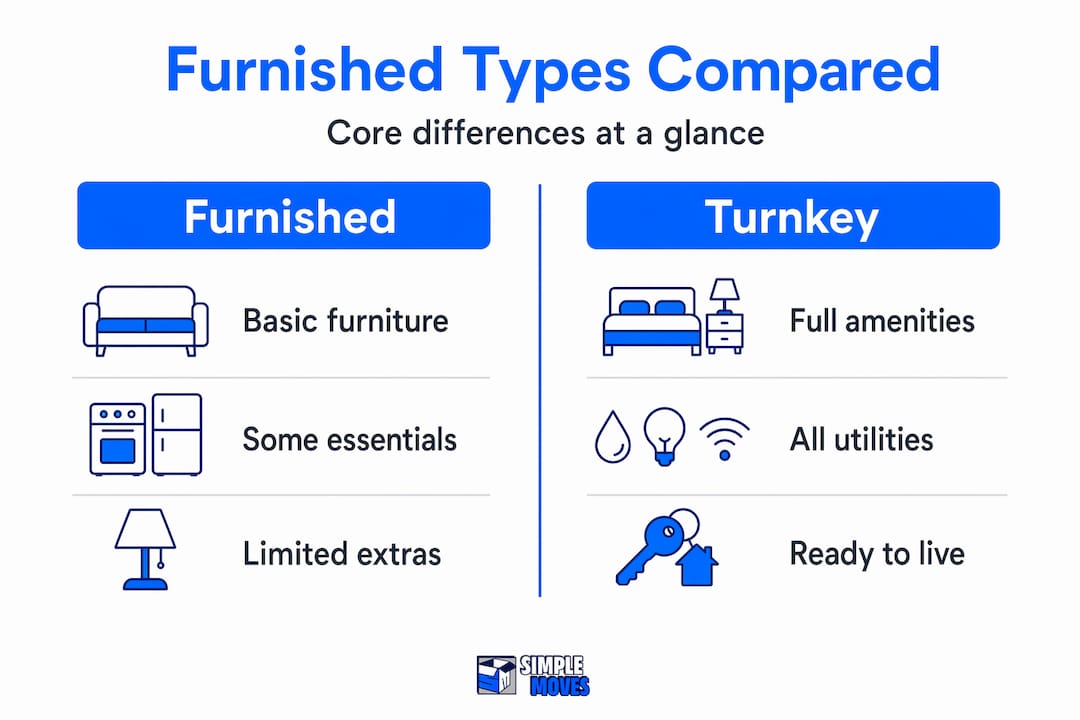
These three terms are used interchangeably, but they mean different things. A furnished unit typically includes the major pieces: a bed, a couch, a table, and basic appliances. A fully furnished unit adds linens, kitchenware, and often cleaning supplies. A turnkey property goes a step further. Turnkey units include furniture, linens, kitchenware, decor, and every essential for immediate occupancy with no additional purchases needed. For the rest of this article, Furnished and Fully Furnished will be referred to as ‘Furnished’.
When you’re planning a furnished unit relocation, knowing which category you’re renting matters. A “furnished” listing might still leave you buying a can opener. A “turnkey” listing won’t.
Typical use cases
Furnished unit relocations cover a wider range of situations than most people realize. Job transfers are the most common, where an employer moves an employee to a new city and needs housing ready immediately. But families going through divorce proceedings, homeowners displaced by fire or flood, people building or renovating a home, and individuals relocating for medical care all use this option regularly.
Furnished housing options typically include utilities, linens, kitchenware, Wi-Fi, laundry access, and flexible lease terms built specifically for these transitions.

Pro Tip: Always request a written amenities list from the property manager before signing. “Furnished” means different things to different landlords, and a written list removes guesswork.
Why furnished relocations beat hotels and bare apartments
The practical case for furnished unit rentals over other options is straightforward once you look at what each option actually costs and delivers.
Hotels feel convenient until you’re living in one for three weeks. The lack of a kitchen, the absence of laundry in the room, and the compressed space all add up to a stressful daily experience. A furnished unit gives you a real kitchen, separate rooms, and a functioning home environment without requiring you to sign a year-long lease.
For employers managing employee relocations, corporate housing saves 30% or more compared to business hotels by consolidating all costs into a single monthly invoice. That’s a significant financial difference, especially for extended moves.
Stability and flexibility during transitions
One of the underappreciated benefits of furnished rentals is cost predictability. Extended furnished rentals consolidate housing, furnishing, and utility costs into one monthly arrangement. You know exactly what you’re paying each month. There are no surprise electricity bills and no weekend rate spikes the way hotels charge them.
For families specifically, this stability is worth a great deal. Children need a consistent environment. You need a workspace. Everyone needs a functioning kitchen. Short-term relocation units designed for this purpose deliver all of that without the chaos of coordinating furniture purchases or utility setups.
The well-being factor
There’s solid evidence that furnished relocations support emotional health during moves. Comfortable furnished homes help relocated employees settle in faster and perform better at work. For families, the same principle applies. When your housing feels like a home rather than a waiting room, the entire relocation feels more manageable.
Comparing furnished relocations to other housing options
It helps to see these options side by side to understand where furnished unit relocation fits best.
| Housing option | Furnishings included | Utilities included | Lease flexibility | Typical cost range | Best for |
|---|---|---|---|---|---|
| Furnished unit rental | Yes | Usually yes | 30 days to 12 months | Moderate to higher | Relocations, job moves, transitions |
| Hotel or extended-stay | Partial | Yes | Night to week | High per night | Trips under 2 weeks |
| Unfurnished apartment | No | No | 12-month standard | Lower monthly | Stable, long-term residents |
| Corporate housing | Yes, fully | Yes | Flexible | Moderate | Employer-sponsored moves |
| Short-term vacation rental | Yes | Usually yes | Night to month | Variable | Leisure, brief visits |
The table shows why furnished unit relocation occupies a specific and useful position. Hotels get expensive fast. Unfurnished apartments require you to buy furniture and set up utilities, which defeats the purpose of temporary housing. Traditional rentals tend to offer better economics for stays beyond six months when your situation has stabilized. But for anything in between, a furnished rental is typically the right fit.
If you’re mid-relocation and your permanent housing isn’t ready yet, you are exactly the person these units were designed for.
How to plan and secure the right furnished unit
Getting into the right furnished unit takes more than searching a listing site and picking the best photos. Here’s a practical sequence that works well for families and individuals alike.
Step one: Define your duration honestly. Most people underestimate how long their transition will last. If you think you need four weeks, plan for six. Lease extensions are possible but not always guaranteed, and switching units mid-relocation adds costs and disruption.
Step two: List your non-negotiables. For families, this means bedroom count, proximity to schools, and workspace for remote jobs. For individuals, it might mean parking, pet policies, or in-unit laundry. Write these down before you search.
Step three: Read the lease exit terms carefully. Some furnished unit rentals charge significant fees for early termination. If your relocation timeline is uncertain, which it often is, find a unit with a clean 30-day notice clause.
Step four: Confirm every amenity in writing. Request a detailed list. Confirm that Wi-Fi speed meets your work needs. Ask whether linens and kitchenware are replaced or cleaned between tenants.
Step five: Budget for what isn’t included. Even the best furnished unit likely won’t have everything. Stock a small moving budget for groceries, a few personal items, and any gaps in the unit’s inventory.
Pro Tip: Ask the property manager if they offer a mid-stay walkthrough at the one-month mark. This lets you flag any maintenance issues before they become bigger problems and confirms you’re being served well.
For families with children, school enrollment timelines add a layer of urgency. Securing your furnished unit at least two weeks before your intended arrival date gives you time to register kids in school and orient to the neighborhood before the pressure of a new job or school schedule begins.
Who pays for a furnished unit relocation
This is where many people have questions, and the answer depends on why you’re moving.
Employers typically cover furnished housing when the relocation is business-related. A job transfer, a temporary assignment in another city, or an onboarding arrangement at a new location all qualify as employer-covered scenarios in most cases. The company often works with a corporate housing provider directly, meaning you may not even see the bill.
For personal relocations, you cover the costs yourself. That said, IRS deductions may apply depending on the nature of your move. Active-duty military members, for instance, have specific deduction eligibility. Others may qualify based on job-related moves that meet IRS distance and timing requirements.
A few practical notes on negotiating costs:
If your employer offers a relocation package, ask specifically whether furnished housing is included or whether you receive a lump-sum allowance. Lump-sum packages often leave housing choices entirely to you, which means knowing your furnished unit options gives you a real advantage in how you spend that money.
Watch for what’s truly bundled. Some furnished unit rentals include all utilities, cable, and parking. Others add those as line items. Clarifying before you sign gives you a true picture of your monthly cost.
My take on furnished unit relocations
I’ve worked alongside families and professionals going through some of the most stressful transitions of their lives. What I’ve consistently seen is that people underestimate how much the right housing arrangement affects everything else about a move.
When someone arrives in a new city and steps into a functioning home, their whole outlook shifts. They have a kitchen, a bed with real linens, a place to regroup. When someone arrives to an empty apartment or a cramped hotel room, the stress compounds.
What I find is that the biggest mistake people make with furnished unit relocations isn’t the unit itself. It’s the timing. They wait too long to secure housing, and then they take whatever’s available rather than what actually fits their needs. A little planning at the front end, particularly around duration and lease exit terms, changes everything.
I also think there’s a misunderstanding about what these units cost. People assume they’re a luxury option. They’re not. For moves that span one to four months, furnished rentals often cost less total than the combination of a hotel plus furniture purchases plus utility setup fees for an unfurnished space. When you run the numbers honestly, they usually hold up well.
My advice is simple: treat housing as part of your moving plan, not an afterthought. The quality of your temporary home directly affects how well you settle into your permanent one.
— Christopher
How Simple Move in Fargo supports your relocation

Whether you’re heading into a furnished unit or coordinating a full household move, Simple Moves in Fargo has the services to support every stage of your relocation. From local to distance-based moving solutions, the team handles the logistics so you can focus on settling in. For moves involving specialty pieces or fragile items, the specialty item handling service protects what matters most in transit. If you need help on arrival, furniture assembly services get your space ready fast. Contact Simple Moves in Fargo for a free quote and find out how the team can make your furnished unit relocation as straightforward as possible.
FAQ
What is a furnished unit relocation?
A furnished unit relocation is when you move into a fully equipped rental unit, complete with furniture, utilities, and household essentials, as part of a planned move or life transition. Stays typically range from 30 days to 12 months.
What does a furnished unit usually include?
Most furnished units include furniture, a bed, kitchen appliances, Wi-Fi, and utilities. Fully furnished and turnkey units go further by adding linens, kitchenware, and decor.
How is a furnished unit different from a hotel?
A furnished unit gives you a complete home environment with separate rooms, a full kitchen, and laundry access, typically at a lower monthly cost than a hotel for stays beyond two weeks.
Who typically pays for furnished unit relocations?
Employers usually cover furnished housing costs for job-related moves, while individuals pay out of pocket for personal relocations. IRS deductions may apply in certain qualifying circumstances.
When does a traditional rental make more sense?
For stays beyond six months where your circumstances are stable, traditional rentals often provide better value than furnished housing, despite the upfront cost of setting up utilities and purchasing furniture.