
Moving quotes can feel unpredictable, and that uncertainty makes budgeting difficult. If you’ve ever received two wildly different numbers from two different companies for the same move, you already know that understanding how moving quotes are calculated is not just useful. It’s necessary. Moving cost calculators give ranges because the final price depends on a combination of variables that most people haven’t thought through before they start calling companies. This guide breaks down every factor in plain terms, so you can budget with confidence and avoid surprises on moving day.
Table of Contents
- Key takeaways
- How moving quotes are calculated: the core factors
- Types of moving estimates explained
- How valuation coverage affects your quote
- Seasonal timing and how it shifts your quote
- Extra fees that change your quote on moving day
- My honest take on what most people get wrong
- Get an accurate moving quote from Simplemovesfargo
- FAQ
Key takeaways
| Point | Details |
|---|---|
| Weight and distance drive base cost | Your shipment’s total weight and travel distance are the two biggest pricing factors for any move. |
| Estimate type affects your final bill | Binding estimates lock in your price; non-binding estimates can change based on actual weight and services. |
| Timing changes what you pay | Moving during summer or on weekends typically costs 20 to 30% more than off-peak scheduling. |
| Valuation coverage is not insurance | Released value protection pays only $0.60 per pound, which rarely covers actual replacement value. |
| Extra fees are avoidable with preparation | Access challenges, added items, and last-minute service changes are the most common sources of surprise charges. |
How moving quotes are calculated: the core factors
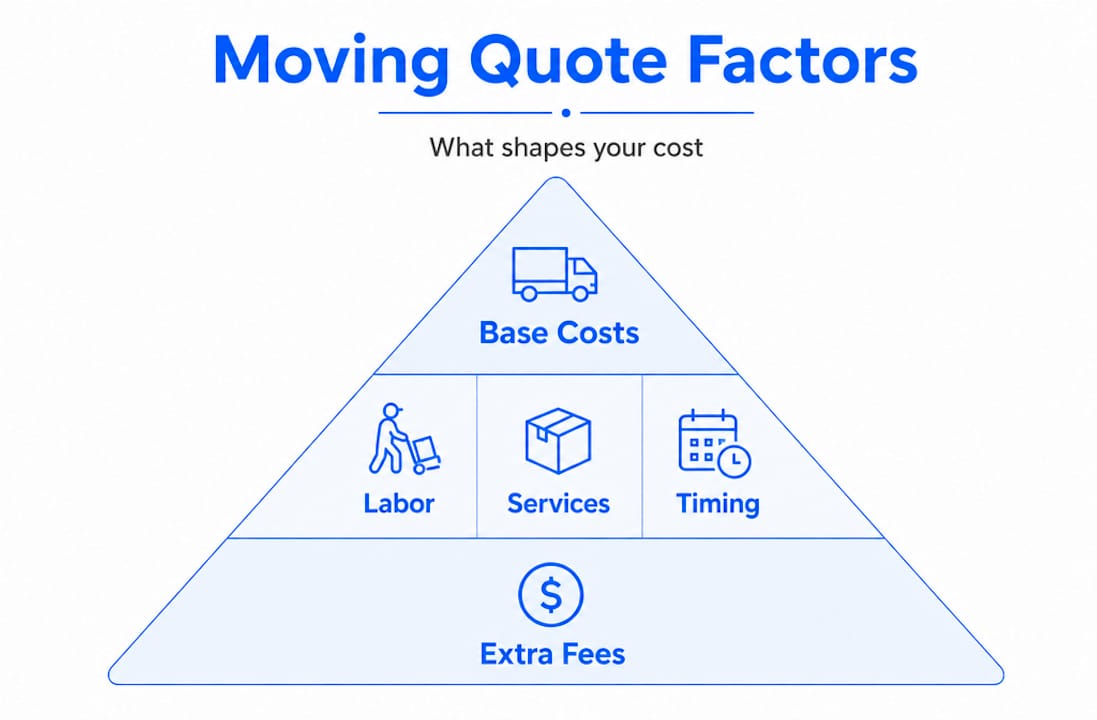
When a moving company builds your quote, they are assembling several cost layers, not just punching in a mileage number. Each layer reflects real expenses on their end, and knowing what those layers are gives you the ability to compare quotes fairly.
Weight and volume sit at the top of that list. For long-distance moves, weight is the primary billing unit. The heavier your shipment, the higher your base rate. For local moves, the calculation flips to an hourly model. Local moves are hourly-based, while long-distance pricing is built around weight, distance, and services combined. A two-bedroom apartment move within Fargo will be billed differently than a cross-country haul of the same furniture.
Distance determines fuel costs, drive time, and sometimes overnight accommodations for the crew. A 50-mile move and a 500-mile move carry fundamentally different cost structures, even if the shipment weighs the same.

Labor covers the number of movers on your job and the time it takes. More movers generally means faster completion, but the hourly rate increases accordingly. A three-person crew moving a three-bedroom house in four hours costs more than a two-person crew moving a one-bedroom in two hours.
Additional services are where many people see their quotes grow beyond their initial expectation. Packing assistance, specialty item handling for pianos or antiques, furniture disassembly and reassembly, and storage all carry separate line items. You can explore what professional packing services typically include to understand how those costs are structured before your quote arrives.
Pro Tip: Before you request a quote, walk through every room and list every item you plan to move, including items in closets, the garage, and the attic. An accurate inventory list is the single most effective tool for getting a quote that matches your final bill.
Types of moving estimates explained
Not all quotes work the same way. The structure of your estimate directly determines how much financial risk you carry, and most consumers don’t realize there are three distinct types until a dispute arrives on moving day.
| Estimate type | Price certainty | Risk level | Best for |
|---|---|---|---|
| Binding | Fixed, no changes | Low | Predictable budgets |
| Non-binding | Varies by actual weight | Medium | Flexible budgets |
| Binding not-to-exceed | Capped maximum price | Very low | Cost-conscious movers |
A binding estimate is a firm contract. The price you receive is the price you pay, regardless of whether your shipment ends up heavier than expected. This is the cleanest option for anyone who needs budget certainty.
A non-binding estimate is an approximation. The final charge is based on what your shipment actually weighs at pickup. Non-binding estimates allow movers to charge up to 110% of the estimated cost at delivery. The remaining balance beyond that 110% is billed afterward, and you have 30 days to pay it. This rule, established by the FMCSA, protects consumers from being held hostage at delivery.
A binding not-to-exceed estimate gives you the best of both worlds. The mover sets a maximum price, but if the shipment weighs less, your final bill drops accordingly. You are never charged above the cap. This is the most consumer-friendly option and worth requesting specifically when you compare quotes.
Providing written estimates and walking customers through differences between these types reduces disputes significantly. Ask every company you contact to specify which type of estimate they are providing, and get it in writing before you commit.
Pro Tip: If a mover gives you a quote over the phone without asking about your inventory, treat that number as a rough placeholder only. Accurate estimates require a physical or virtual survey of your belongings.
How valuation coverage affects your quote
Valuation coverage is one of the most misunderstood parts of a moving quote. Consumers often confuse valuation liability limits with full replacement insurance, and that misunderstanding can be costly.
Every licensed mover must offer two options.
Released value protection is the default, and it costs you nothing extra. The catch is significant: released value covers only $0.60 per pound per item. A 30-pound flatscreen television worth $800 would receive a maximum payout of $18. That figure rarely comes close to actual replacement cost.
Full value protection changes that equation. If an item is lost or damaged, the mover must repair it, replace it with a similar item, or pay you its current market value. Movers typically charge 1 to 1.5% of your total declared shipment value for this coverage. On a $20,000 shipment, that translates to $200 to $300 added to your quote. For items with genuine replacement value, that cost is usually worth it.
Movers are required to document your valuation selection on the bill of lading and obtain your signature to comply with FMCSA rules. If you are moving high-value possessions like art, jewelry, or electronics, you may also want to look into a third-party insurance policy that covers declared value more precisely than either carrier option.
Seasonal timing and how it shifts your quote
The calendar plays a bigger role in what you pay than most people expect. Moving companies experience genuine demand surges at predictable times of year, and that demand directly affects pricing.
Moving during peak summer months increases costs by 20 to 30% due to high demand and limited availability. May through August is the busiest stretch for residential moves, driven by school calendars, lease cycles, and favorable weather. If your move has any flexibility, shifting even a few weeks outside that window can produce real savings.
Weekends and end-of-month moves cost more due to lease cycles and demand. Most leases end on the last day of the month, which means move-out days cluster around that time. Scheduling your move on a Tuesday or Wednesday in the middle of the month is one of the simplest ways to reduce your quote without changing anything else about your move.
Booking early also matters. Moving companies lock in pricing for confirmed bookings, and the closer you get to your move date, the less flexibility they have to offer competitive rates. Booking six to eight weeks in advance gives you more negotiating leverage and a wider choice of dates.
If you’re planning a long-distance move, timing becomes even more significant because fuel surcharges, driver availability, and delivery windows all factor into the final number.
Extra fees that change your quote on moving day
Even a well-prepared quote can shift if circumstances on moving day don’t match what was originally described. Knowing which scenarios trigger extra charges helps you prevent them.
Access challenges are among the most common sources of added fees. If movers cannot park the truck close to your door, they may charge a long-carry fee for the extra distance. Flights of stairs, elevators, and narrow hallways can also add to the labor time calculation.
Additions to your shipment after the estimate is finalized are a straightforward cost driver. Even small additions can void a binding estimate or trigger extra charges on any estimate type. If you realize you want to add items after your survey, contact your mover and request a revised written estimate before moving day.
Specialty items that weren’t included in the original survey, like a piano, hot tub, or large gun safe, require different equipment and handling. Moving specialty items involves rigging, extra padding, and sometimes additional manpower, all of which carry separate fees.
Communicate clearly with your moving crew and coordinator before moving day. Walk through your home in advance using the preparation guide at how to prepare your home for movers to identify anything that could create complications. Transparency upfront saves money and stress at delivery.
Pro Tip: If any details of your move change after your estimate is issued, always request an amended written estimate before the move happens. A verbal confirmation is not enough protection if a dispute arises later.
My honest take on what most people get wrong
I’ve worked through enough moving scenarios to know that the biggest source of regret isn’t the price itself. It’s the gap between what someone expected to pay and what they actually paid.
In my experience, the two things that cause that gap most often are incomplete inventory surveys and choosing the wrong estimate type. Most people rush through the inventory because they think it’s just a formality. It isn’t. An incomplete inventory is essentially a blank check. When the crew shows up and finds twice as much as was listed, the estimate becomes meaningless. I’ve seen clients face significantly higher bills simply because they forgot to mention a storage unit or a workshop full of tools.
The other pattern I’ve noticed is that people gravitate toward the lowest-quoted number without asking what type of estimate it is. A low non-binding estimate sounds appealing right up until the truck is weighed. A binding not-to-exceed estimate with a slightly higher number often ends up being the better deal.
My honest advice: spend more time on your inventory than you think you need to. Ask every mover you speak with whether their estimate is binding, non-binding, or binding not-to-exceed. And don’t let the quote conversation end without discussing valuation coverage options in writing. Those three steps alone will prevent the majority of moving disputes I’ve seen play out.
— Christopher
Get an accurate moving quote from Simplemovesfargo
Understanding how moving costs are determined is the first step. Getting a quote that actually reflects your specific move is the next one.

Simplemovesfargo serves the Fargo-Moorhead area with residential, commercial, and distance-based moves, and every quote starts with a thorough survey of your inventory, not a quick phone estimate. The team handles full-service packing, specialty item transport, furniture assembly, and labor-only options for clients who need flexibility. Whether you’re moving across town or planning a long-distance relocation, Simplemovesfargo provides written estimates that clearly identify all cost factors before your move begins. Businesses needing commercial moving services can also get customized quotes built around operational timelines. Request your free quote today and get a number you can actually plan around.
FAQ
How are moving costs determined for a local move?
Local moves are typically billed hourly based on the number of movers, the time required, and any additional services like packing. Access factors such as stairs or long carries may add to the total.
What is a binding not-to-exceed estimate?
A binding not-to-exceed estimate sets a maximum price for your move. If your shipment weighs less than estimated, your final bill is reduced. You are never charged above the quoted cap.
Why does moving in summer cost more?
Peak season demand from May through August means fewer available crews and higher rates. Moving costs can increase by 20 to 30% during this period compared to off-peak months.
What does released value protection actually cover?
Released value protection covers only $0.60 per pound per item. A 30-pound TV worth $800 would receive a maximum payout of $18, which is far below actual replacement value.
What causes a moving quote to increase on moving day?
Common causes include items not listed in the original inventory, access challenges like stairs or long carries, and specialty items that require extra equipment. Requesting a revised written estimate before the move begins prevents most of these surprises.